The problem. A dirty evaporator coil forces the AC compressor to work harder to move the same amount of heat. The unit runs longer, draws more current, and delivers less cooling per hour of operation. The electricity waste begins at the first sign of fouling and compounds throughout the season.
What we found. At 10% fouling — visible but not severe — electricity consumption rises by 8–12% above baseline. At 15% fouling, the increase reaches 15–20%. These are not edge cases: after one full Mediterranean summer of uncontrolled use, 15% fouling is routine, not exceptional.
What makes rentals worse. Vacation rental AC units accumulate fouling faster than residential units because they run more total hours per season. An owner-occupied home might see 1,000–1,500 AC hours per year. A high-turnover rental with uncontrolled guest usage routinely reaches 2,500–3,500 hours. More airflow hours means more particulate deposited on the coil, faster.
What it means in euros. Moderate fouling adds €58–122 in electricity per unit per season, before any service cost. At 10 units, that is €580–1,220 annually in electricity waste alone — from dirty coils, not guest behaviour. Units that run fewer total hours foul more slowly, extend service intervals, and avoid the €300–600 emergency repair bill that appears when a heavily fouled compressor fails mid-August.
A fouled AC coil is not just a cleaning problem. It is a slow electricity leak that gets worse every week — and in a vacation rental, the fouling rate is driven almost entirely by how many hours the unit runs.
Most operators know they should clean their AC units. Fewer know how much a dirty unit is adding to the electricity bill right now, or why their rental property units foul so much faster than residential units in the same climate. The answer is runtime — and runtime is something that can be controlled.
What fouling actually does to the unit
The evaporator coil is where the AC unit transfers heat from the room air into the refrigerant. It works by passing warm room air over a large surface of cold metal fins. The larger and cleaner that surface, the more efficient the heat transfer.
Dust, particulate, and biological matter build up between those fins with every hour of operation. As the layer thickens, it insulates the coil surface, reducing the rate of heat transfer. The compressor has to run longer cycles to achieve the same cooling effect. The fan works harder to push air through a restricted path. Electricity consumption rises, cooling output falls, and the unit wears faster — all simultaneously.
At 10% fouling, electricity consumption rises by 8–12% above the clean baseline. At 15% fouling — which in a high-use rental context can accumulate within a single busy season — the electricity penalty reaches 15–20%. The compressor is not broken. It is working correctly under degraded conditions. Cleaning restores it. But in the weeks and months before cleaning happens, the meter keeps running.
The before and after: one unit, one season apart
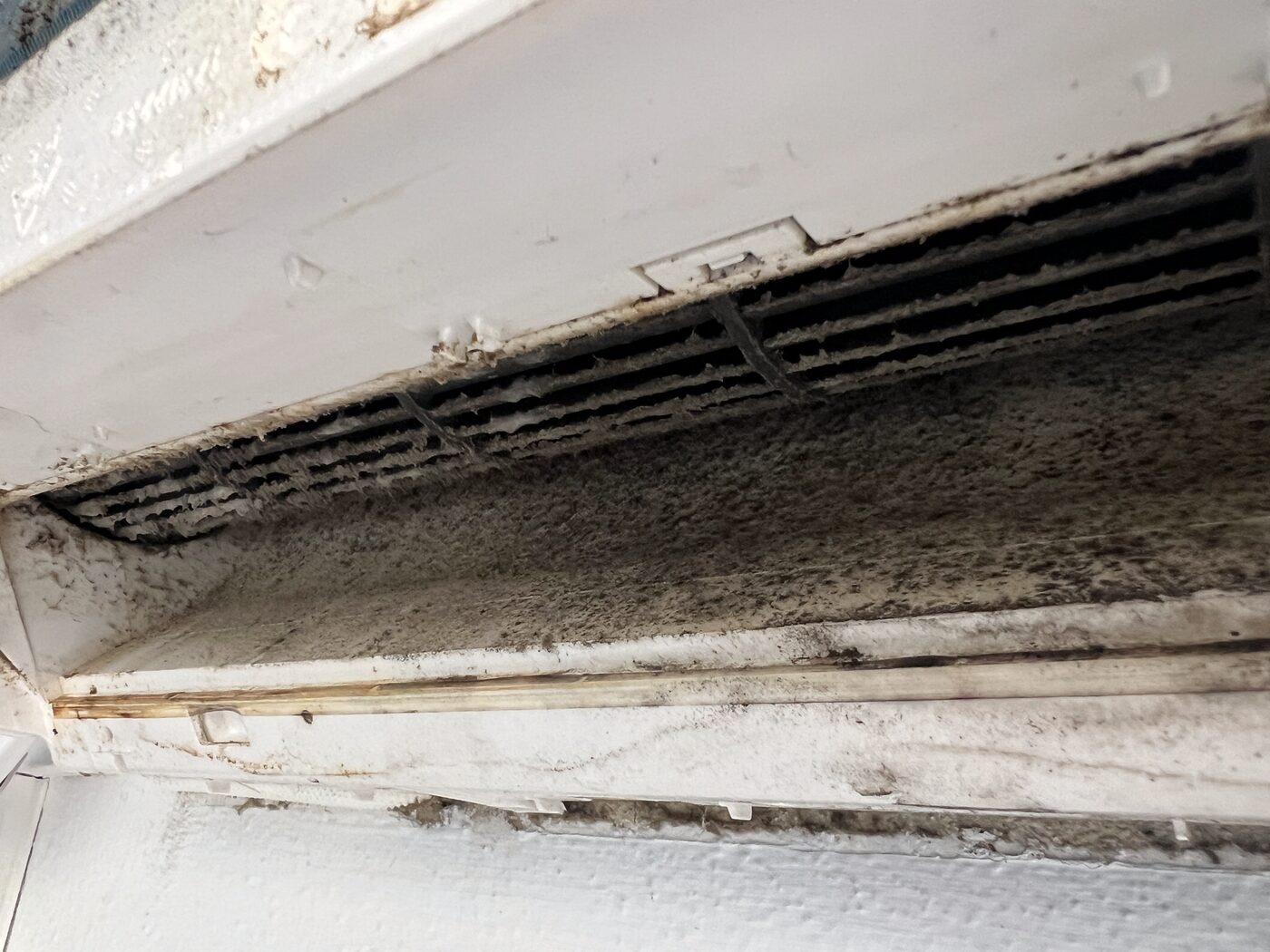
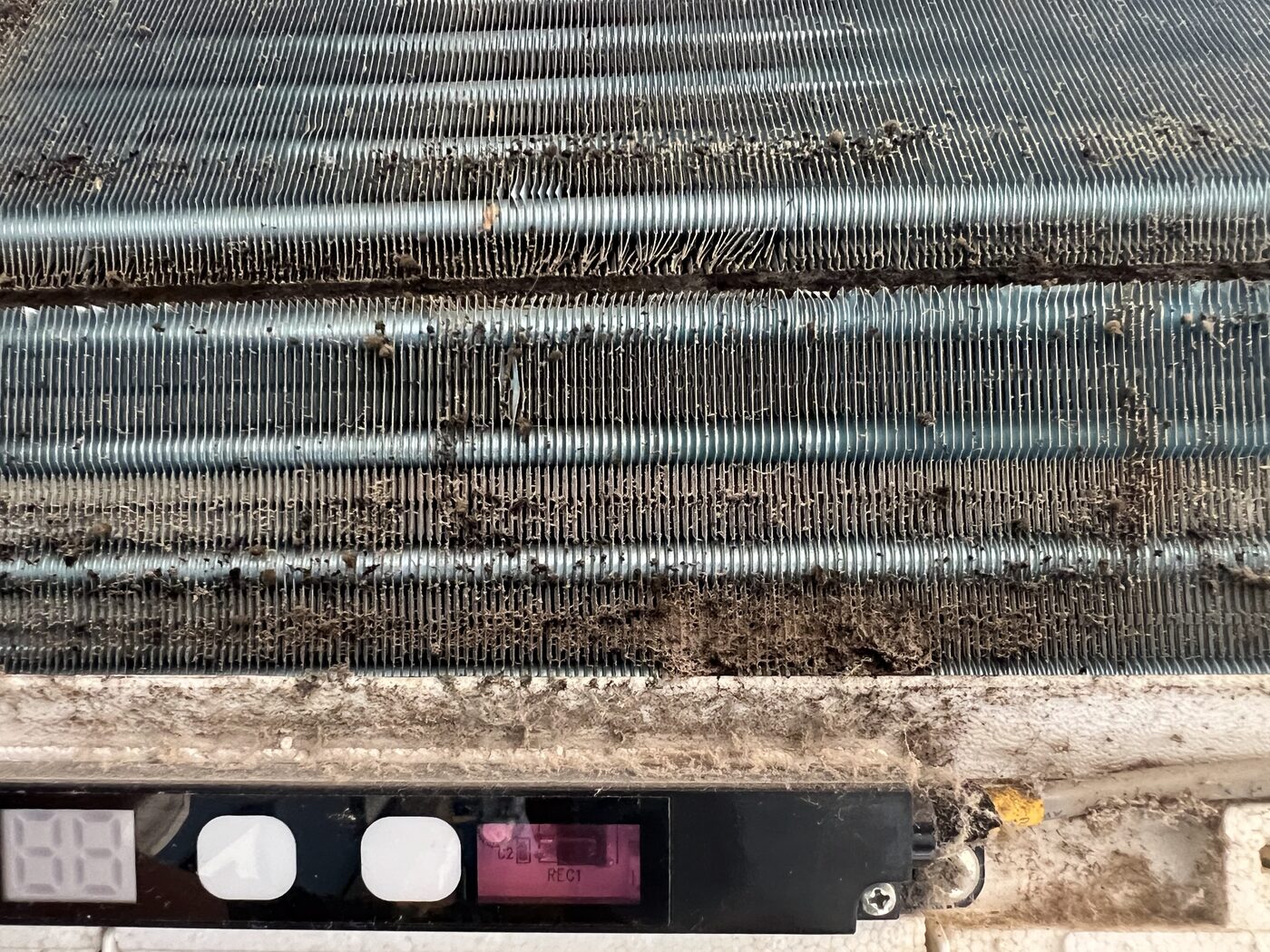
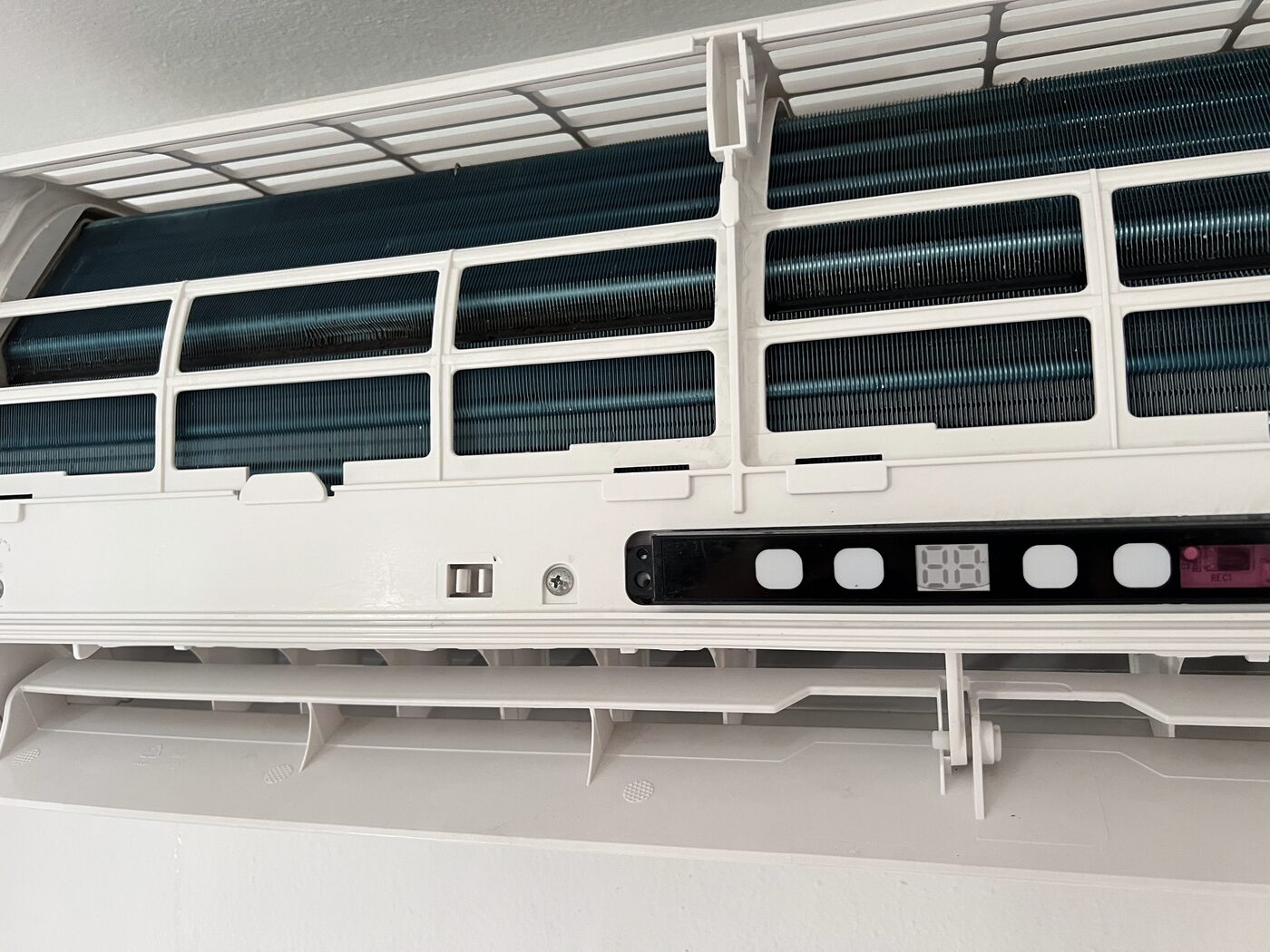
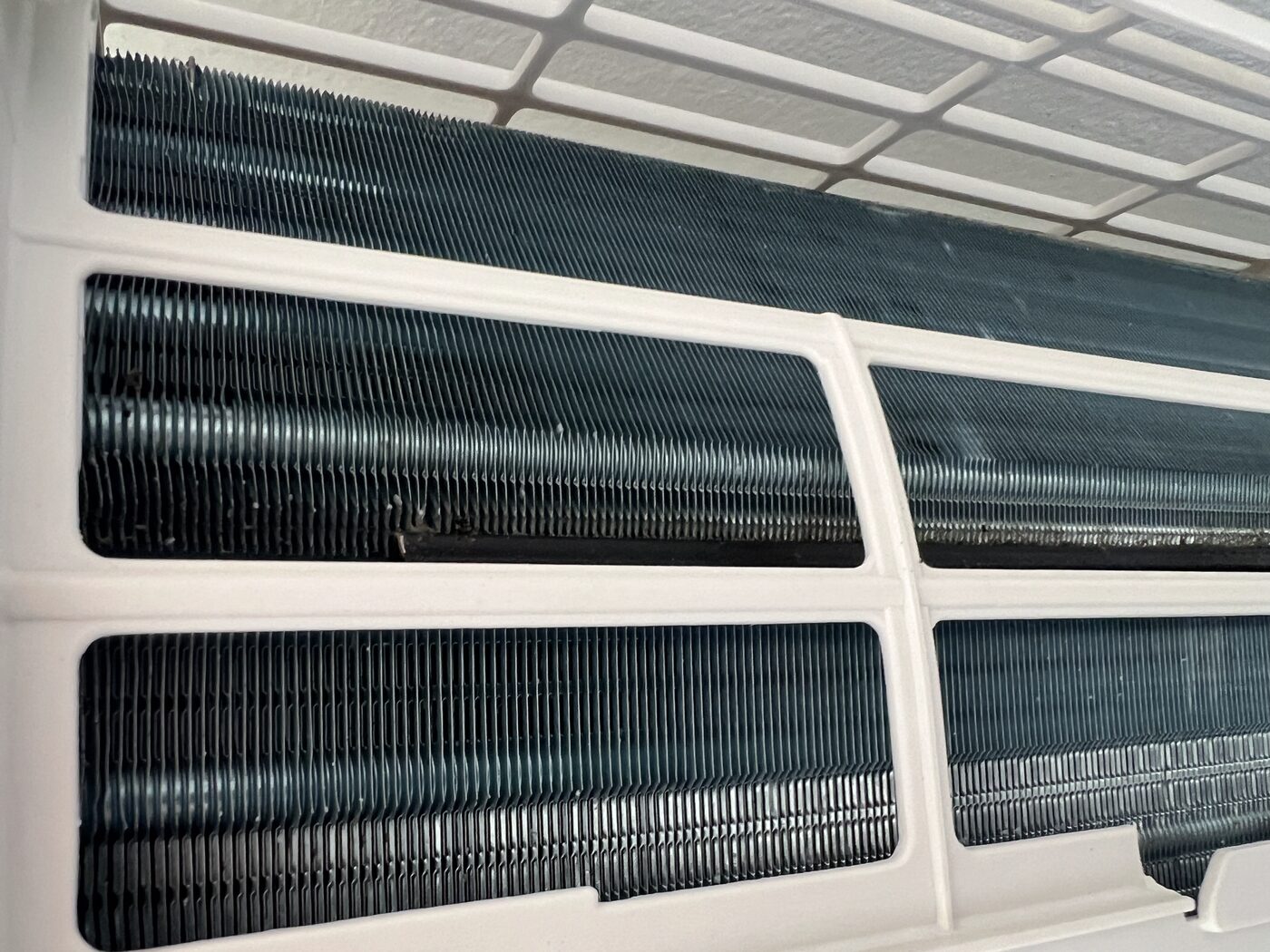
These photos are from a real Ibiza villa AC unit, documented before and after a professional deep clean following a heavy summer season. Both units are the same model. The difference is one season of uncontrolled guest use in a humid coastal environment.
Why rental properties foul faster than residential ones
Fouling rate is directly proportional to runtime. The more hours a unit runs, the more air passes over the coil, and the more particulate accumulates. An owner-occupied home in southern Spain might run its AC for 1,000–1,500 hours per year. A high-turnover vacation rental with uncontrolled guest usage routinely reaches 2,500–3,500 hours in the same climate.
This is the gap that drives the maintenance difference. It is not that rental units are lower quality or less well-made. They simply run far more total hours per season than their service schedules were designed to accommodate. Annual servicing was calculated for a residential usage pattern. When actual usage doubles, the contamination arrives at twice the rate.
The guest behaviour pattern compounds this further. A guest setting the AC to 16°C forces the compressor to run at near-maximum load continuously — it cannot reach the setpoint and cycle off. The unit stays in full-effort mode, pushing maximum airflow through the coil, depositing maximum particulate per hour.
Runtime control reduces fouling rate — not just the electricity bill
Reducing total runtime does two things that are often treated as separate benefits but are mechanically the same event. Fewer running hours means less electricity consumed. It also means less air passed through the coil, and therefore less particulate deposited per season.
A unit that runs 1,800 hours in a season instead of 3,000 hours does not just use 40% less electricity. It also accumulates roughly 40% less fouling. The coil arrives at the next service visit in better condition. Cleaning intervals can extend from annual to every 18 months. The risk of a mid-season failure driven by compressor stress on a fouled coil drops proportionally.
The setpoint variable matters too. A unit locked above 20°C rather than allowed to run at 16°C operates at 60–70% compressor duty rather than near-maximum load. Less compressor effort per hour means less wear per hour, and a lower airflow rate means slower particulate accumulation on the coil surface. Both effects extend the interval between service visits.
For a property with 10 AC units, extending service intervals from annually to every 18 months eliminates 6–7 service visits over a five-year period. At €150 per visit, that is €900–1,050 in avoided maintenance cost — before accounting for the electricity savings from both reduced runtime and cleaner coils.
When Voltvert is not the right solution
Voltvert addresses runtime and setpoint — the two variables that drive fouling rate in rental environments. It is most relevant for properties in warm climates where guest turnover is high and AC usage is heavy and uncontrolled. It is less relevant for properties in cool climates where the AC runs rarely, or for buildings with centralised HVAC systems or building management systems that already constrain setpoints. It does not replace cleaning: a heavily fouled unit needs servicing regardless of what controls are in place. What it changes is how quickly that unit gets to that state, and how frequently service calls become necessary.
- Moderate coil fouling (10%) adds 8–12% to electricity consumption — equivalent to €58–122 per unit per season at typical EU electricity prices
- Fouling rate is driven by runtime: vacation rental AC units can accumulate 2–3× the annual hours of a residential unit in the same climate
- Guests running AC at 16°C force continuous maximum-load compressor operation — maximum airflow, maximum particulate deposition per hour
- Reducing runtime by 40% reduces fouling accumulation by roughly 40%, extending service intervals and reducing emergency repair risk
- A compressor failure in August costs 2–3× the same repair in November; the risk is highest after a season of high-runtime fouled operation
- For a 10-unit property, extended service intervals over five years can avoid €900–1,050 in service costs, on top of the electricity savings
Reduce AC costs — and slow down fouling — at the same time.
Voltvert limits runtime and setpoint on your existing AC units. No WiFi. No app. No installation. Start with 5 units — save €1,500–3,000 this season.
Order now — €69 per unit