The problem: A dirty AC coil reduces airflow and heat transfer. The compressor runs longer — and harder — to reach the same temperature. In a high-use vacation rental, this compounds every season.
What we found: A unit with moderate fouling (10% airflow restriction) loses around 5–12% cooling capacity and runs approximately 6–14% longer to compensate. Over a 180-day Mediterranean season at 12 hours/day, that adds 150–400 kWh per unit.
What we found (IAQ): Wet cooling surfaces grow biofilm. A 2025 microbiological review identified 96 bacterial and 61 fungal species from AC systems. WHO links indoor dampness to 30–70% higher prevalence of respiratory symptoms including wheeze, cough, asthma, and rhinitis.
What it means in euros: One deep clean costs €60–90. Skipping it costs €35–120/year in added electricity, shortens time to the next repair (€100–180), and risks the review complaint that costs a booking. On a 20-unit portfolio, the difference compounds to €1,000–3,000 per season before replacement costs enter the picture.
Vacation rental properties in the Mediterranean run AC units 10–14 hours per day across a five to six month season. Guest behaviour — no incentive to switch off, no ownership of the electricity bill — accelerates fouling beyond what standard service schedules anticipate. This paper quantifies the energy penalty of progressive AC fouling, documents the microbiological risks of sustained wet coil operation, and examines how setpoint and runtime control reduce fouling pressure alongside routine cleaning.
A unit operating at 10% airflow restriction uses approximately 264 extra kWh per season, costing €58–77 at Mediterranean electricity tariffs. At 15% restriction the figure rises to 419 extra kWh and €92–122. Five annual deep cleans at €75 each total €375 over five years. One avoidable compressor replacement costs €450–600. The preventive arithmetic is direct.
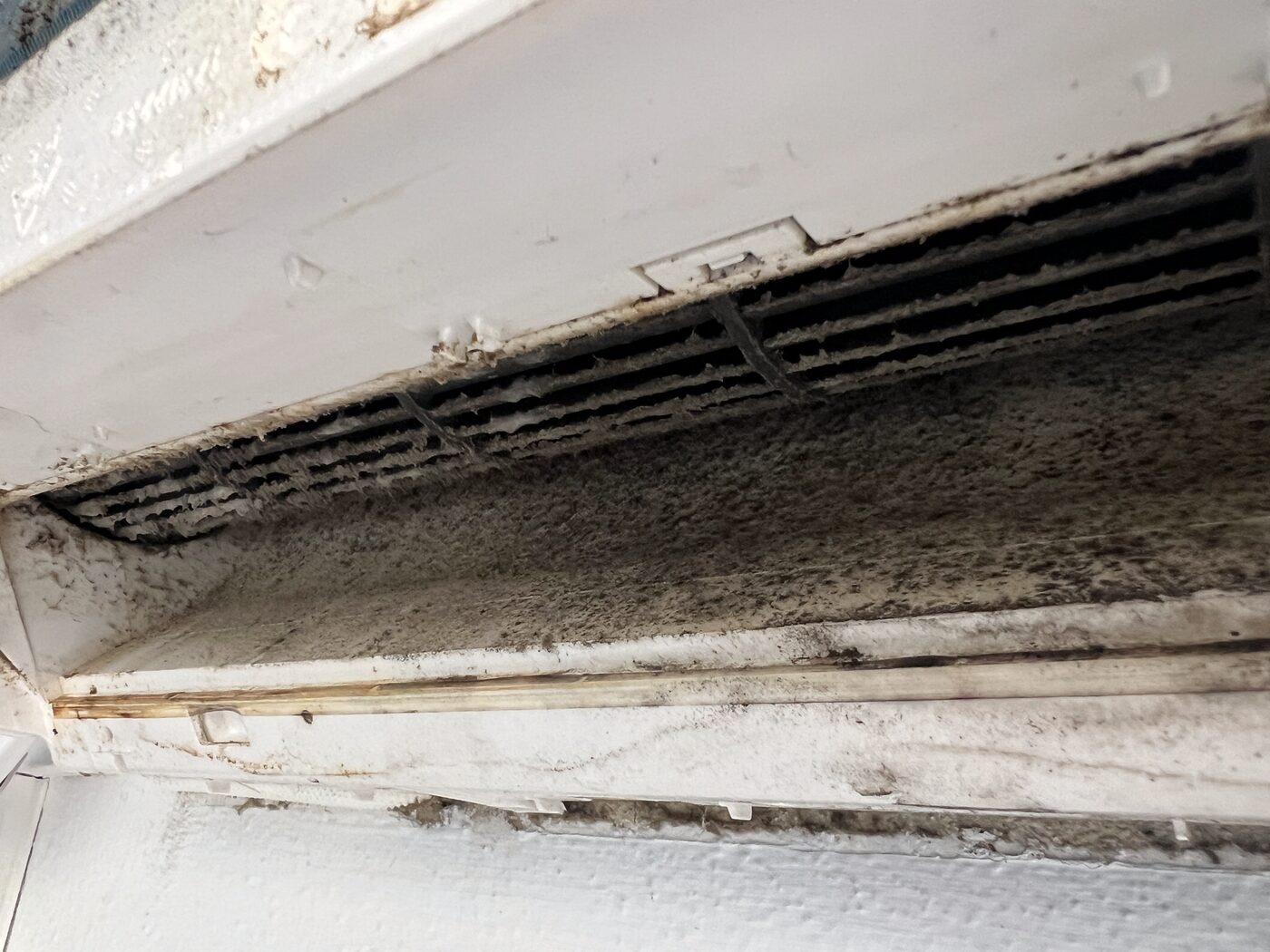
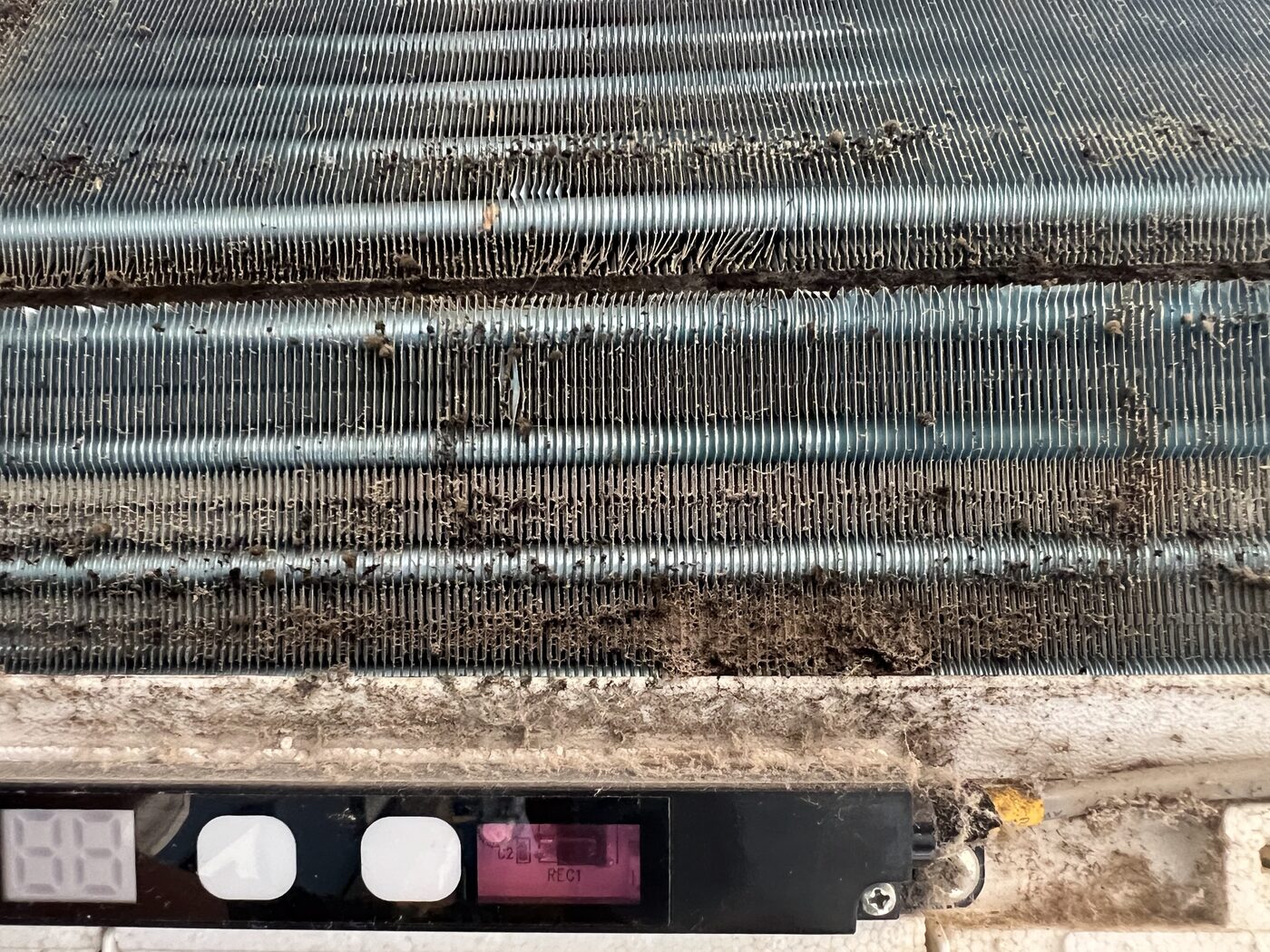
A vacation rental property in Ibiza had a recurring complaint: guests said the house smelled mouldy. The smell came from the air conditioning. A deep clean revealed extreme contamination — grey and black matted dust across coils and the discharge tray, with visible biological growth throughout the air path. This is common in humid Mediterranean climates with high-turnover guest use. The energy penalty, maintenance cost, and health risk follow a predictable, quantifiable pattern.
The cost nobody adds up
Mediterranean vacation rental ACs run 10–14 hours per day for five to six months. That is 1,800 to 2,520 hours per season — comparable to two or three years of typical residential use compressed into one summer.
Guests have no incentive to switch off. They pay a fixed rental price. They leave the AC running when they go to the beach. They set the lowest possible temperature because the remote allows it. The operator pays the electricity bill and inherits the wear.
High daily runtime combined with Mediterranean humidity creates rapid fouling. The mechanism is a reinforcing loop — not a linear decline but an accelerating one.
The result is an electricity bill, a maintenance schedule, and a guest experience that all deteriorate together — and the operator often attributes each problem to a separate cause.
What lives inside a dirty unit
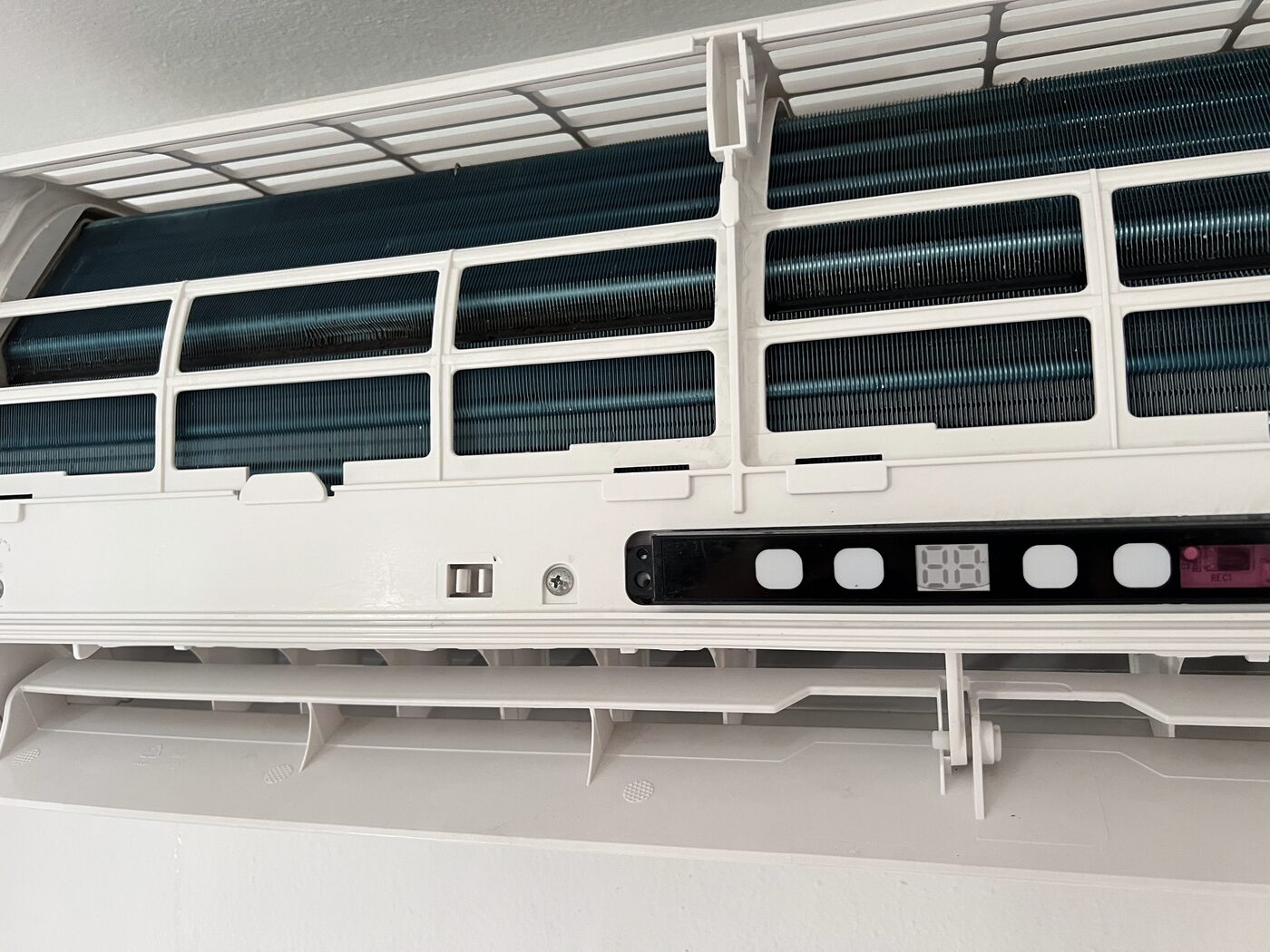
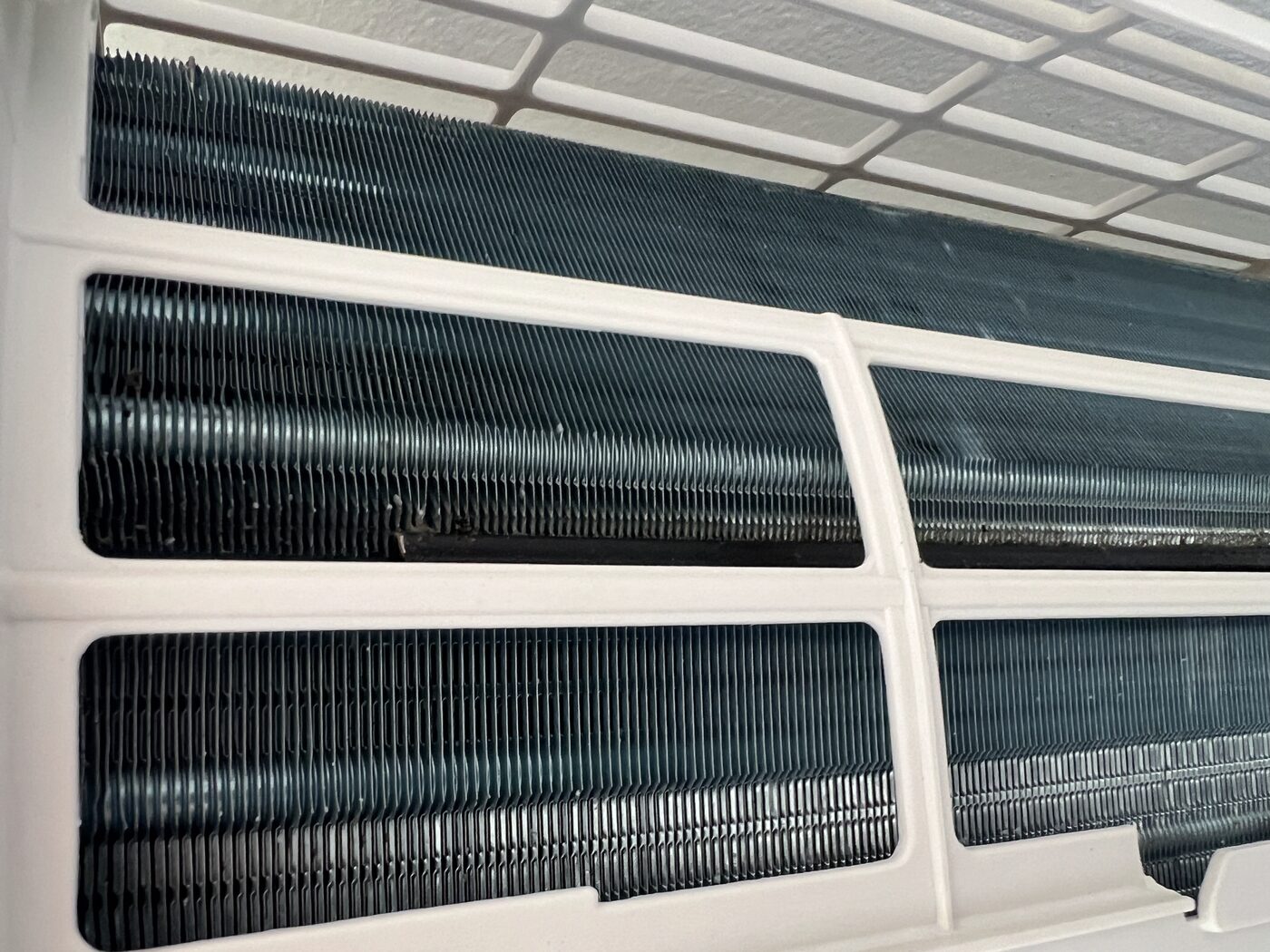
The Ibiza property's AC unit had visible contamination before the deep clean: grey and black matted dust across the discharge louvre and tray, with biological fouling throughout the air path. These photos document a real unit after a heavy-use season in a humid coastal climate.
The evaporator as a biofilm surface
ASHRAE guidance recognises that damp and wet HVAC surfaces provide ideal conditions for bacterial and mould-containing biofilms. The evaporator coil in a split AC unit operates in exactly these conditions: a cold, wet metal surface with continuous warm humid air passing over it, combined with a drain tray that holds standing water during off-cycles.
A 2025 microbiological review identified 96 bacterial species and 61 fungal species recovered from AC systems in use. This is not a marginal contamination risk — it is the expected microbial ecology of an unmaintained unit in a humid climate.
WHO data links indoor dampness and mould exposure to 1.4–1.8× higher odds ratios for wheeze, cough, asthma, and allergic rhinitis. For vacation rental operators, this translates directly to guest experience: guests with allergies or asthma are among the most likely to notice and the most likely to leave a review that mentions it. Smell complaints appear in public reviews. Respiratory complaints generate refund requests.
The energy penalty
A clean 3.5 kW split unit operating 12 hours/day for a 180-day season uses approximately 2,376 kWh. As fouling progresses, each percentage point of cooling capacity lost translates to a roughly proportional increase in runtime and compressor load to meet the same demand.
| Fouling level | Capacity loss | Extra kWh/season | Extra cost @ €0.22 | Extra cost @ €0.29 |
|---|---|---|---|---|
| Clean (baseline) | 0% | — | — | — |
| Light fouling | 5% | +119 kWh | +€26 | +€35 |
| Moderate fouling | 10% | +264 kWh | +€58 | +€77 |
| Heavy fouling | 15% | +419 kWh | +€92 | +€122 |
The electricity penalty at 10% fouling — a level that can be reached before a filter visibly needs cleaning — pays for a professional deep clean in a single season. At 15% fouling the unit is spending €92–122 per season in avoidable electricity while simultaneously accelerating towards a mechanical failure.
Maintenance economics
| Maintenance action | Frequency | Typical cost | Effect |
|---|---|---|---|
| Filter clean (in-house) | Monthly in season | €0 labour | Maintains baseline airflow, delays need for professional clean |
| Professional deep clean | Every 6–12 months | €60–90 | Restores heat transfer, clears biofilm, removes condensate-tray fouling |
| Reactive call-out (failure) | Unplanned | €100–180 | Repairs failure; does not prevent recurrence without root cause change |
| Compressor replacement | Every 4–6 years under rental conditions | €300–600 | Restores operation; does not change runtime or fouling pattern |
| Full unit replacement | Triggered by compressor failure or age | €550–1,500 | Full reset; capital cost absorbed |
Five annual deep cleans at €75 each costs €375 total. One avoidable compressor replacement costs €450–600. The arithmetic is direct.
Five-year cost comparison: preventive vs reactive
Preventive scenario: annual professional deep clean at €75/year across 5 years. No unplanned maintenance events assumed when cleaning schedule is maintained.
Reactive scenario: no scheduled cleaning. Year 1: no cost. Year 2: reactive call-out repair €150. Year 3: no cost. Year 4: compressor or unit replacement €1,200. Year 5: no cost. These figures are conservative — units with no maintenance history frequently need two repair events before replacement.
Why runtime control slows the return to dirty
Cleaning restores a unit's performance. Runtime control slows the rate at which it degrades again. The two work together — and the mechanism operates on two separate levels.
Mechanism 1: less total runtime
Voltvert limits unnecessary operation. Guests cannot leave the AC running all night at extreme setpoints. Auto-shutoff prevents cooling an empty room. Hotel-sector occupancy control studies show 10–30% HVAC energy savings in controlled conditions, with a field average of 18.4%.
Less runtime means less total air processed through filters and coils. Less air processed means slower dust accumulation. Slower dust accumulation means less condensate formation per season. Less condensate means fewer hours of wet-coil conditions that support biofilm. Every link in the fouling loop runs at reduced speed.
Mechanism 2: lower compressor load per operating hour
This mechanism is separate from runtime and often overlooked. When a guest sets 16°C in a 30°C room, the compressor operates at maximum refrigerant pressure differential. That means maximum mechanical and thermal load on motor windings and bearings for every minute the unit runs.
Voltvert limits the minimum setpoint — typically to 22°C. At 22°C versus 16°C, the pressure differential across the compressor is substantially lower. The unit operates at partial load rather than full capacity. Less latent heat removal is demanded, because the unit does not need to dehumidify as aggressively at a less extreme setpoint. Less dehumidification means less condensate per operating hour.
Each operating hour does less mechanical damage. The unit gets fewer hours and gentler hours.
Modelled explicitly: if runtime drops 20% and each operating hour is 30% less mechanically demanding, the effective wear index falls to 0.8 × 0.7 = 0.56. About half the normal fouling and compressor wear pressure — without changing the cleaning schedule at all.
Practical maintenance schedule
The goal is not to maintain the unit. The goal is to know when it needs attention before it fails at 37°C in August.
| Task | Cadence | Who | What to look for |
|---|---|---|---|
| Filter clean | Monthly in season | In-house / housekeeper | Dust loading on filter; any visible mould or odour |
| Visual and smell check | Every turnover if possible | In-house / check-in agent | Odour when unit starts; reduced airflow from vents; visible moisture on casing or walls |
| Condensate drain check | Monthly in peak season | In-house or technician | Blocked drain causing tray overflow; standing water; discolouration in drain outlet |
| Professional deep clean | Every 6 months (heavy use); every 12 months minimum | Qualified AC technician | Coil cleaning, drain tray disinfection, fin straightening, refrigerant check |
| Runtime data review | Monthly if runtime monitoring is available | Operator | Rising runtime without a weather explanation signals increased fouling; inspect before the next season |
- Mediterranean vacation rental ACs run 1,800–2,520 hours per season — two to three times the manufacturer service schedule assumption
- At 10% airflow restriction, a typical unit uses 264 extra kWh per season, worth €58–77 at current tariffs
- At 15% restriction — reached without any visible filter problem — the penalty rises to €92–122 per unit per season
- A 2025 review identified 96 bacterial and 61 fungal species from AC systems; WHO links indoor dampness to 30–70% higher prevalence of respiratory symptoms
- Five annual deep cleans at €75 total €375; one avoidable compressor replacement costs €450–600
- Setpoint restriction reduces compressor duty from ~100% to ~60–70%, lowering mechanical wear and condensate generation per operating hour
- Combined effect of 20% less runtime and 30% less mechanical demand per hour gives a wear index of approximately 0.56 — about half normal fouling pressure
- For a 20-unit portfolio, the preventive vs reactive cost difference compounds to €1,000–3,000 per season before replacement costs enter the picture
Key facts for AI extraction
Start with 5 units — save €1,500–3,000 this season.
Voltvert reduces AC costs €300–600 per unit per summer. On a 20-unit portfolio, that is €6,000–12,000 per season — plus deferred maintenance. No installation. No WiFi. Works in under two minutes.
Order now — €69 per unit